Your Bag Became a Charging Station: The One-Cable Fix for Tech Clutter
The moment your bag stopped being a bag
It happens in line at a coffee shop. You reach for your wallet and pull out a USB-C cable, a power bank, a tangle of earbuds, and an adapter for a laptop you left at home. The wallet is somewhere under all of it. Your bag has quietly become a charging station with a shoulder strap.
This is not a character flaw. It is a design problem. Tech has crept into the everyday carry one cable at a time, and most of us never stopped to audit the result. The bag still looks minimal from the outside. Inside, it is a junk drawer with a zipper.
How tech multiplies in small spaces
Hybrid work made this worse. You might carry a laptop on Tuesday, work from a coffee shop on Thursday, and fly to a conference on the weekend. Each scenario comes with its own cable, its own dongle, its own just-in-case charger. Add the free promotional cables that arrive with every device, and the bag becomes a sedimentary layer of past intentions.
The problem is not that we own too much tech. It is that we let tech live everywhere. A cable in the tote, a cable in the backpack, a cable in the carry-on, and a mystery cable at the bottom of the closet. When you cannot find the one you need, you buy another. The collection grows without anyone deciding it should.
The real cost of cable creep
Cable creep charges rent in several ways. The first is weight. A 10,000mAh power bank weighs about half a pound. A wall brick, two cables, and a case of earbuds add another half pound. That is a pound of gear you lift every time you leave the house, and it is often gear you do not use.
The second cost is time. Digging for a cable at a gate, a desk, or a client meeting is a small tax that compounds. The third is damage. Loose cables scratch phone screens, snag lining, and bend connectors. The fourth is decision fatigue. Every loose item is one more thing your brain has to track.
There is a sustainability cost too. Duplicate cables are small, cheap, and easy to replace, which makes them easy to waste. A minimalist bag is not just a style choice. It is a way to stop buying the same object three times because you cannot find the first one.
The one-cable rule
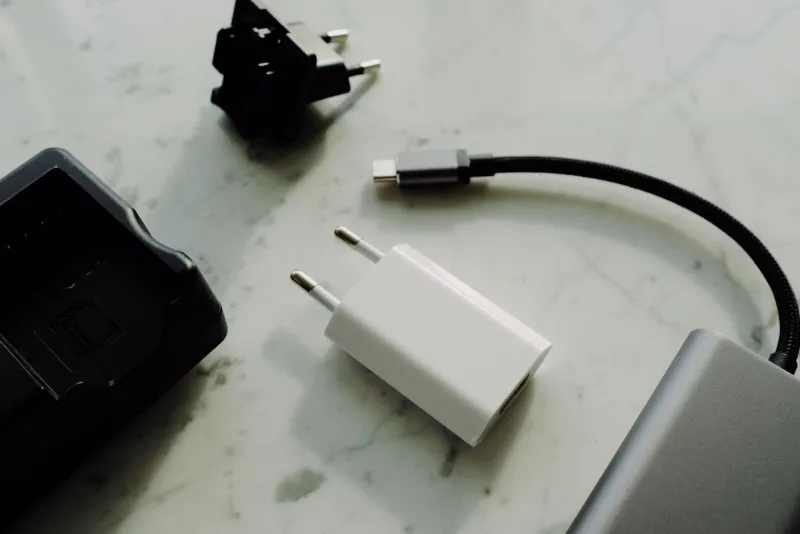
Start with a rule that sounds too simple: one charging cable leaves the house. For most US readers in 2026, that means a single USB-C to USB-C cable. It charges your phone, your power bank, and most modern laptops. If you need a wall brick, choose one with a USB-C port and leave the cable attached to it.
If you use an iPhone with a Lightning port or an older device, add one short adapter and keep it attached to the cable with a small silicone tie. Do not add a second cable just because it came in the box. The rule is not about deprivation. It is about knowing exactly where your cable is at all times.
Travel is the one exception. A separate travel pouch can hold a longer cable and an international plug adapter. That pouch lives in your suitcase, not your everyday bag. When you get home, it gets unpacked. The everyday bag goes back to one cable.
Build a tech pouch, not a junk drawer
A dedicated pouch is the difference between a system and a pile. Look for a flat rectangular pouch about seven by five inches, with a bright interior, elastic loops, and a smooth zipper. It should weigh almost nothing and fit inside your work tote or backpack without adding bulk.
The pouch has three jobs: hold the cable, hold the power bank, and hold the earbuds. That is it. A small wall brick can live there if you regularly work away from home, but it should be the only extra. The bright interior matters because dark lining hides dark cables. You want to see what is missing at a glance.
The pouch is a room with a door. When it is full, something moves out. When you buy a new cable, an old one leaves. When you switch earbuds, the old case does not stay in the bag as a backup. The pouch stays small enough that you can feel when it is getting crowded.
The Sunday reset
Five minutes a week keeps the system from collapsing. Empty the pouch onto a table. Wipe the inside. Coil the cable and secure it with a tie. Charge the power bank. Remove receipts, wrappers, and any adapter you did not use that week.
Then ask one question: what did I actually use? If the answer is the cable and the earbuds, the rest is luggage. If you did not use the power bank in a week, it can live in your desk drawer until a travel day. The everyday pouch is for the everyday day.
What stays out
The old cable that only works if you hold it at an angle. The promotional cable from a conference. The three adapters for devices you no longer own. The power bank that never holds a charge. The tablet you might use. The second pair of earbuds. The emergency charger that is only an emergency because it is always dead.
A backup should be a backup, not a resident. If you need a charger in your car, keep one in your car. If you need one at the office, keep one at the office. The bag does not need to duplicate your entire desk.
The travel tweak
For flights, add one international plug adapter and one longer cable to the travel pouch. Keep them contained. TSA security is easier when cables are coiled and visible, and hotel desks are easier when you know where the brick is. A clear pouch or a bright lining also helps when you are packing in a dim hotel room.
Do not let the travel pouch become a second everyday pouch. It should be a small, specific kit that appears when you travel and disappears when you return. The rest of the year, it lives in the suitcase.
The takeaway
A minimalist bag is not a bag with nothing in it. It is a bag where everything has a job. Tech should support your day, not colonize it. One cable, one pouch, one weekly reset. Less weight, more intention. Carry less, mean more.