The Tote Tax: What Women Quietly Spend to Look 'Put Together' at Work
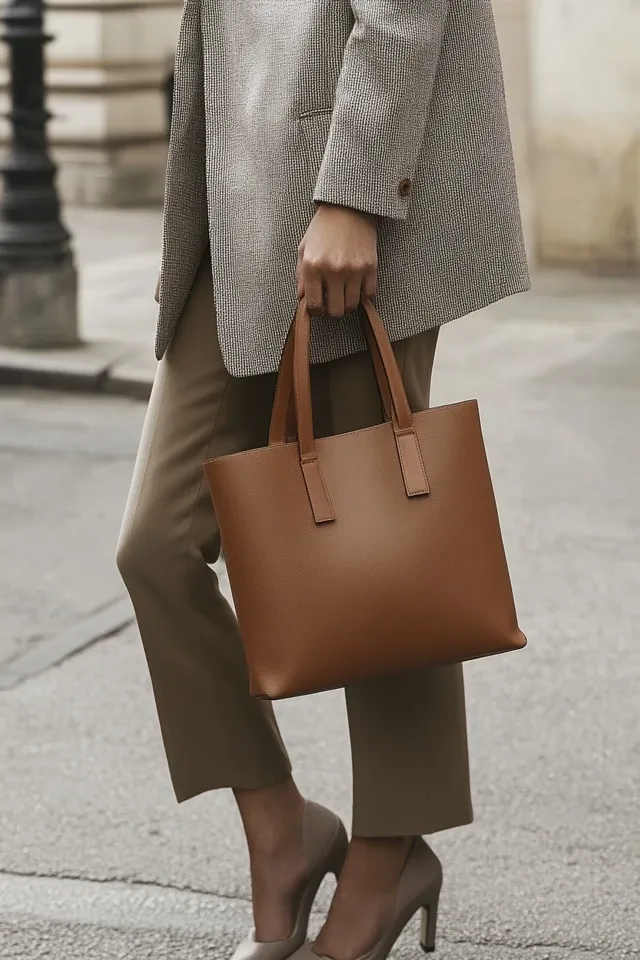
Photo: confident professional woman with structured work tote bag in modern office, via mytrendboutique.com
Nobody hands you a dress code that says "expensive bag required." It's never written down. But ask any woman who has walked into a client meeting, a promotion conversation, or a first day at a new job, and most will tell you the same thing: the bag matters. Or at least, it feels like it does. And that feeling has a price.
Call it the tote tax—the quiet, unreimbursed, never-discussed cost of looking appropriately "put together" in American professional life. It doesn't show up on any expense report. It's just expected.
The Unspoken Line Item
The numbers back up the anecdote. Women in the US spend, on average, meaningfully more than men on work-adjacent appearance—clothing, grooming, and yes, bags—and carryalls sit squarely in that gap. A man can carry the same scuffed nylon laptop sleeve for a decade and be called low-maintenance. A woman carrying the same bag risks being read as unpolished, or worse, as someone who isn't thriving.
We talked to women across a few industries, and the pattern was striking.
Jasmine, a consultant in her late twenties in New York, put it this way: "My first week at the firm, I noticed every woman carried basically the same tote. Different shades, same silhouette. I bought one within a month. Was anyone going to say anything if I didn't? Probably not out loud. But I didn't want to find out."
A teacher in Ohio told us she budgets for a new work bag every few years not because she wants to, but because the daily grind destroys them—and because "you can't show up to parent conferences with something falling apart. They notice."
A startup founder in Denver was the most blunt: "I've watched people judge my funding stage by my bag. It's absurd. But absurd doesn't mean it isn't happening."
How We Got Here
The work tote didn't become a status object by accident. For decades, professional style advice aimed at women has treated the bag as shorthand—proof of taste, of seriousness, of having your life handled. Fashion media anointed the "it" tote. Office culture absorbed it. Somewhere in there, a leather rectangle with a logo became a proxy for whether you belonged in the room.
The unfairness is layered. Men's professional uniforms are basically standardized—suit, watch, done. Women's are a moving target that shifts by industry, city, and even by who's running the meeting. And the bag, uniquely, sits at the intersection of utility and signaling: it has to actually carry your work, and simultaneously speak on your behalf before you open your mouth.
The Contrarian Case: Let the Work Do the Talking
Here's where we'll take an unpopular position, at least for a site that sells bags: your competence is the luxury item. The bag is just the container.
This isn't an argument for showing up sloppy. It's an argument for proportion. The most impressive professional any of us know—the person whose judgment you trust, whose emails you actually read—is not impressive because of a tote. And the expensive-bag-as-armour strategy has a hidden flaw: it's a subscription. The signal decays. Logos go in and out. What read as "arrival" in 2019 reads as "trying" now. Competence compounds. Leather depreciates.
So what's the practical move? A few principles:
- Buy for your actual workload, not your imagined audience. If the bag carries your laptop, your files, and your life comfortably for 250 days a year, it's doing its real job. The room will adjust.
- One excellent work bag beats three adequate ones. The Five-Slot logic applies doubly when money is tight—concentrate the spend where you'll actually use it.
- Notice when you're buying for fear. If the purchase is really about not being judged, pause. Fear is a terrible personal shopper.
- And maybe, gently, change the culture you control. Compliment the work, not the bag. Mentor without mentioning the tote. The tote tax only survives because everyone keeps paying it silently.
Carry Less. Mean More.
At Beu Bag, we obviously believe in bags—well-made ones, chosen deliberately, carried for years. What we don't believe is that a bag owes anyone an explanation of your worth. The best thing you can bring into a meeting room is a clear head and good work. The bag just needs to hold your laptop and stay out of the way.
The women we interviewed are, one by one, figuring this out. Jasmine eventually did buy the firm-approved tote—but she also stopped replacing it every time the trend shifted. "It's a tool," she says now. "A really nice tool. But I'm the one they hired."
That's the whole argument, really. Buy the bag. Carry it well. Then let what's inside it—the skills, the judgment, the preparation—do the talking. That's a look no logo can fake and no trend can retire.