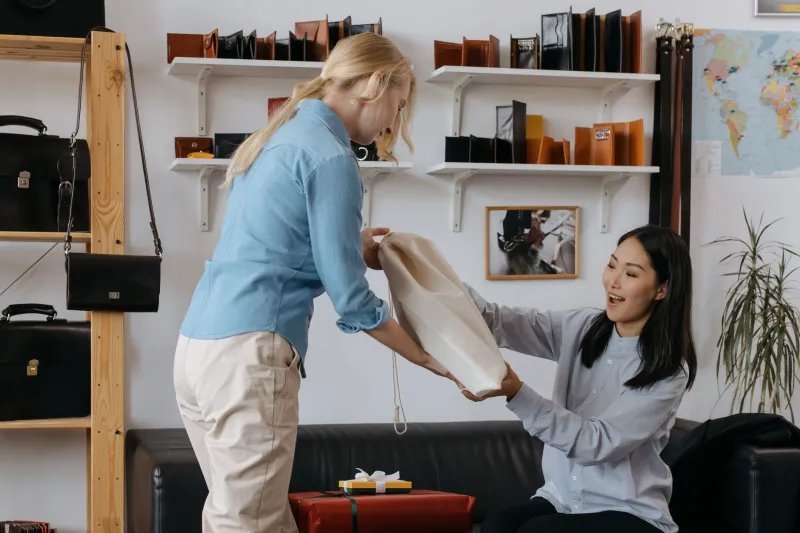
The Guilt Bag: Why We Keep Carrying Gifts That Were Never Really Ours

It arrives wrapped in tissue paper, sometimes with a ribbon. The giver watches your face with anticipation, and you smile—genuinely, because the gesture is real, because the love behind it is real—even as something in your gut quietly registers: This isn't me.
Maybe it's a brightly colored structured bag from your mom, who has always loved bold accessories and assumes you do too. Maybe it's a trendy logo piece from your best friend, who shops at completely different stores than you do and picked it because she thought it was cute. Maybe it's a practical nylon commuter bag from your partner, who was trying to be helpful and saw you struggling with your current tote and thought, problem solved.
None of these people did anything wrong. They were paying attention, in their own way. They were trying to say I see you through the language of a gift.
The problem is, the bag they chose says something about who they think you are—or who they want you to be—not who you actually are.
The Performance of Gratitude
Here's where it gets complicated. Because you are grateful. You genuinely appreciate that someone thought of you, spent money on you, took time to wrap something and present it to you with hope. That part is real.
But gratitude and compatibility aren't the same thing. You can be deeply thankful for a gift and still know, in your honest heart, that you will never willingly reach for it.
So begins the performance. The bag gets carried on exactly the occasions the giver might witness—family dinners, group events, the one time she's in town and you know she'll notice. The rest of the time, it lives on a shelf, occasionally reshuffled to look like it's in rotation. You tell yourself you're being thoughtful. You're honoring the relationship. You're not being materialistic or ungrateful.
But there's a tax on this performance, and it's paid in small, daily moments: the morning you open your closet and feel a flicker of guilt, the event where you carry it and feel slightly unlike yourself all night, the slow accumulation of wearing something that doesn't fit your life like a low-grade, persistent discomfort.
Why We're Wired to Do This
The psychology here isn't complicated, but it is deeply human. Gifts carry the emotional weight of the relationship they came from. Rejecting a gift—or even just not using it—can feel like rejecting the person who gave it. And most of us are not willing to risk that, especially with people we love.
There's also the specific cultural script around women and gratitude. We're socialized early to receive things graciously, to prioritize the feelings of the giver, to smooth over any friction with warmth and accommodation. Saying "I appreciate this, but it's not really my style" feels almost transgressive—even though it's honest, even though it's kind in its own way.
So we carry the bag. We perform the gratitude. We slowly build what might be called a guilt closet: a collection of well-intentioned pieces that represent other people's visions of us.
The Real Disrespect Is in the Performance
Here's a reframe worth sitting with: wearing something you hate, out of obligation, is not actually more respectful than being honest.
When you carry a bag that doesn't fit your life, you're not honoring the relationship—you're managing it. You're prioritizing the giver's comfort over your own authenticity, which sounds noble until you realize it means you're not really letting the person know you at all. You're letting them know a version of you that's been edited for their benefit.
The people who love you—the ones who gave you the bag in the first place—generally want to know you, not a curated performance of gratitude. Most givers, if they're the kind of people worth keeping close, would rather know what you actually love than watch you carry something that makes you feel vaguely wrong every time you use it.
Honesty, delivered with warmth, is its own form of intimacy.
What to Do With a Bag You'll Never Love
This is the practical question, and it deserves a practical answer. You have options, and none of them require you to either lie or blow up a relationship.
Pass it along with a story. Some bags land in the wrong hands the first time. If the piece is beautiful and well-made but simply not your aesthetic, find someone in your life who would genuinely love it—and tell the original giver, if it feels right. "I passed it to my sister, she's obsessed with it" is a generous outcome, not a betrayal.
Donate it thoughtfully. A bag you never use helps no one. Giving it to someone who will actually carry it—through a shelter donation, a clothing swap, or a resale platform—is more respectful to the object, and arguably to the giver's intention, than letting it collect dust.
Keep it if there's genuine sentiment—but be honest about why. Some gifts are kept not because they're used but because they're meaningful. That's okay. Just be clear with yourself about the difference between keeping something because you love it and keeping it because you feel you have to.
The Permission You've Been Waiting For
You are allowed to have a personal style that doesn't accommodate every well-meaning gift you've ever received. You are allowed to know what you like, carry what fits your life, and release the rest without guilt.
Your aesthetic isn't a rejection of the people who love you. It's a reflection of who you actually are—and the people who genuinely know you will respect that, even if it takes a conversation to get there.
The bags we carry are one of the most consistent, visible expressions of our identity. When every piece in your collection was chosen—really chosen, by you, for you—there's a coherence to it that feels like confidence. Like coming home.
Carry less. Mean more. And give yourself permission to only carry what's actually yours.